
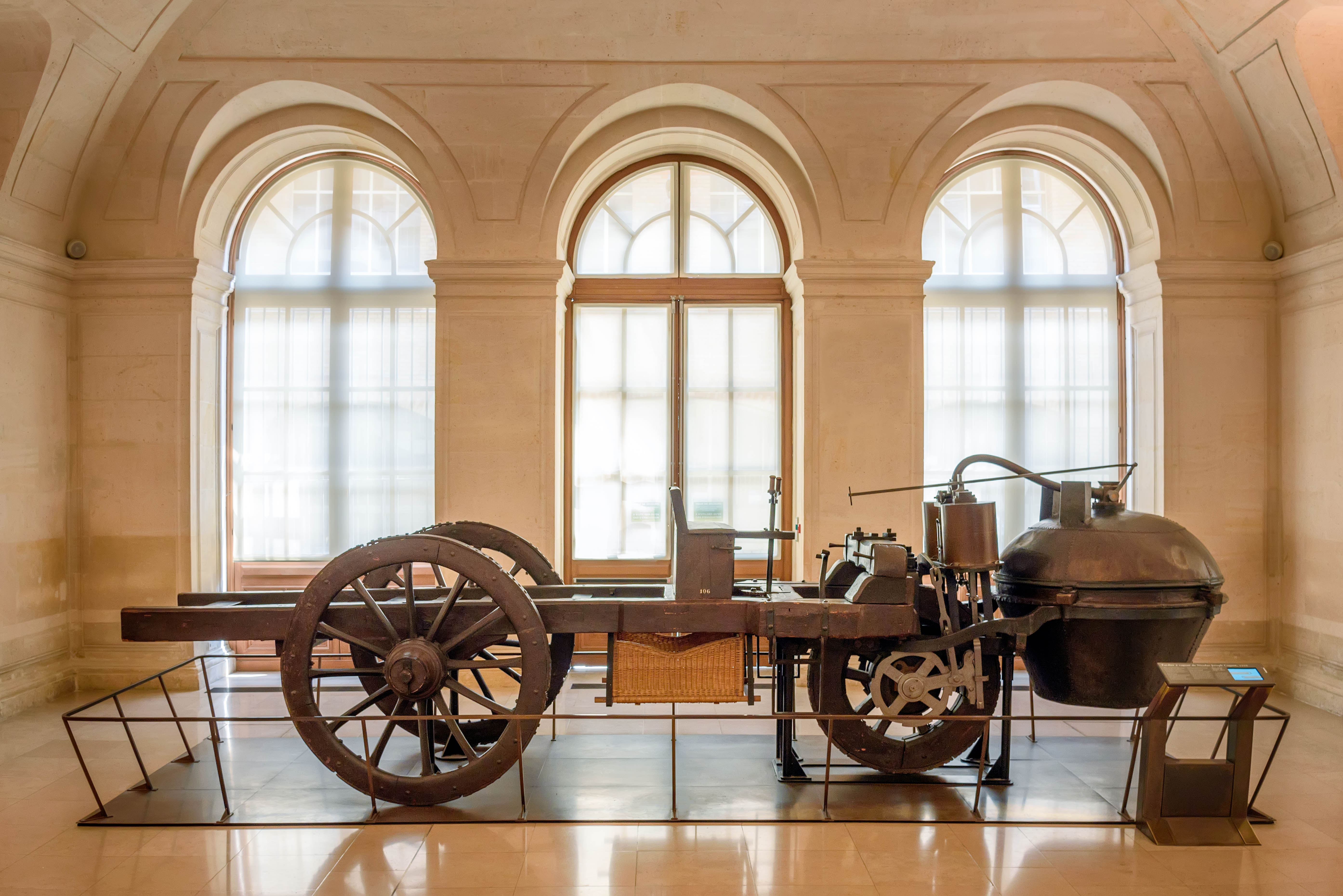
 By Joe deSousa - Joseph Cugnot's 1770 Fardier à Vapeur, CC0, https://commons.wikimedia.org/w/index.php?curid=41801028
Few inventions have changed daily life as thoroughly as the automobile. Today, there are more than 1.4 billion motor vehicles on the world's roads (International Organization of Motor Vehicle Manufacturers [OICA], 2023). Cars determine where we live, how cities are laid out, what we breathe, and how we spend leisure time. Yet the car did not arrive fully formed. It was built, refined, fought over, and reimagined across roughly two centuries of experimentation, industrial ambition, and social change.
This article tells that story in plain language. It is written for readers who are curious about history but may not have a technical background. The goal is not to survey every model or manufacturer but to trace the large arc of how the car came to dominate modern life and where it may be headed next. The article draws on established scholarship in the history of technology and transportation studies, with citations provided for readers who wish to explore further.
Before the Automobile: Steam, Horses, and the Search for Self-Propulsion
The desire to move without animal power is much older than the car itself. As early as 1769, French engineer Nicolas-Joseph Cugnot built a steam-powered tricycle capable of carrying artillery (Flink, 1988). Although it could manage little more than walking speed and had to stop frequently to build up steam pressure, it demonstrated a crucial principle: a vehicle could carry its own power source. Over the next century, steam coaches appeared on British roads, offering an early glimpse of motorized public transport before rail travel largely eclipsed them (Mom, 2004).
The internal combustion engine changed everything. By burning a fuel such as coal gas, and later gasoline, inside a cylinder, engineers could produce power in a form far more compact and controllable than steam. German engineer Nikolaus Otto built a practical four-stroke internal combustion engine in 1876, establishing the technical foundation that almost every gasoline car still uses today (Womack et al., 1990). The question was no longer whether self-propelled road vehicles were possible but whether anyone could make them reliable, safe, and affordable enough for ordinary use.
The Pioneers: Benz, Daimler, and the Birth of the Modern Car
In 1885, German engineer Karl Benz completed what is widely recognized as the first true automobile: a three-wheeled vehicle with a gasoline engine, electric ignition, and a chassis designed specifically for road travel rather than adapted from a carriage (Flink, 1988). The following year, his compatriot Gottlieb Daimler produced a similar machine. Crucially, Benz's wife Bertha took the car on a long-distance journey in 1888, traveling approximately 100 kilometers from Mannheim to Pforzheim. Her trip was partly a publicity stunt and partly a practical test; she stopped at pharmacies along the way to buy fuel and improvised repairs with a hatpin and her garter. The journey proved the car was viable beyond a workshop demonstration (Sachs, 1992).
In France, Emile Levassor and Rene Panhard placed the engine at the front of the vehicle and connected it to the rear wheels through a clutch and gearbox, a layout that became standard for decades. By the 1890s, car races, particularly on French public roads, were drawing crowds and generating press coverage that helped establish the automobile as a symbol of modernity and speed (Pettifer & Turner, 1984). The car was no longer a curiosity; it was becoming a product.
Mass Production and the Model T: The Car Becomes Everyday
For all its excitement, the early automobile was a toy of the wealthy. A car in 1900 cost more than most workers earned in a year. Henry Ford set out to change that. In 1908, Ford's company introduced the Model T, a simple, sturdy car designed for rough American roads. Ford's real innovation, however, was not the car itself but how it was made. In 1913, Ford opened a moving assembly line at his Highland Park plant in Michigan. Workers stayed in one place while the car moved past them; each person performed a single task repeatedly. The result was a dramatic fall in production time and cost (Hounshell, 1984).
By the early 1920s, Ford was producing a Model T every 24 seconds. The price fell so steeply that ordinary working families could afford one. Ford also paid his factory workers enough to buy the products they made, a deliberate strategy to expand the market (Brinkley, 2003). The social consequences were profound. People could live farther from their workplaces. Rural communities gained access to towns and cities. The car gave individuals a new kind of freedom of movement that had never existed before.
General Motors, Ford's main rival, introduced an important innovation of its own: the idea of annual model changes and a range of cars at different price points, so that buyers could aspire to trade up over time (Sloan, 1963). While Ford sold utility, GM sold aspiration. Both approaches proved enormously successful and shaped the culture of automobile consumption that persists today.
The Automobile Remakes the Landscape
As car ownership spread, especially in the United States, cities and towns reorganized themselves around the needs of drivers. Suburbs grew rapidly because families could now commute from quieter, less expensive land on the outskirts. Shopping moved from dense urban centers to highway-side strip malls and, later, enclosed shopping malls with vast parking lots. Restaurants, motels, gas stations, and drive-in theaters emerged as entirely new types of building shaped by the assumption that customers would arrive by car (Jackson, 1985).
Road building became a major government priority. The United States Interstate Highway System, authorized in 1956 under President Dwight Eisenhower, was partly inspired by German Autobahns Eisenhower had seen during World War II and by military arguments about moving troops quickly across the country. It reshaped American geography, but it also displaced hundreds of thousands of people, disproportionately from Black and low-income communities whose neighborhoods were cut through or demolished to make way for urban freeways (Mohl, 2002).
Similar processes, though with local variations, occurred in Europe, Australia, Japan, and elsewhere. The car was not simply adopted into existing cities; it actively transformed them, often in ways that proved difficult to reverse.
Safety, Regulation, and the Consumer Movement
The spread of the car brought a sharp rise in traffic deaths. By the mid-twentieth century, tens of thousands of people were dying on American roads each year. For a long time, the dominant explanation blamed drivers: if only people were more careful, accidents would not happen. In 1965, a young lawyer named Ralph Nader published Unsafe at Any Speed, a damning critique of the Chevrolet Corvair that argued the car industry was building vehicles with preventable design flaws and suppressing safety research (Nader, 1965).
The book caused a political sensation. Congress passed the National Traffic and Motor Vehicle Safety Act in 1966, creating federal authority to set safety standards for the first time. Seatbelts, padded dashboards, and collapsible steering columns became mandatory. Later decades added airbags, anti-lock brakes, and electronic stability control. Traffic deaths in the United States, measured per mile driven, fell by more than 90% between the 1970s and the 2020s, a remarkable public health achievement enabled by a combination of engineering, regulation, and changing social norms about drunk driving (Tefft, 2012).
Oil, Environment, and the Limits of the Gasoline Era
The automobile ran on petroleum, and for most of its history that seemed an inexhaustible resource. The oil shocks of 1973 and 1979, caused by geopolitical crises in the Middle East, abruptly exposed how dependent the world economy had become on cheap fuel (Yergin, 1991). Long lines at gas stations and suddenly unaffordable heating bills brought the issue to public attention in a visceral way. Smaller, more fuel-efficient Japanese cars gained market share in the United States almost overnight, a shift that American manufacturers were slow to match.
Environmental concerns added a further dimension. Urban smog, caused partly by vehicle exhaust, became a serious health problem in cities from Los Angeles to Tokyo. California led the way in regulating tailpipe emissions, and the U.S. federal government followed with Clean Air Act amendments. Catalytic converters, unleaded fuel, and fuel-injection systems all helped reduce emissions per vehicle, although the sheer growth in the number of cars on the road meant total emissions continued to rise (Doyle, 2000).
By the late twentieth century, scientists had established that carbon dioxide from burning fossil fuels, including gasoline, was driving global climate change. The automobile sector became one of the central fronts in debates about how to reduce greenhouse gas emissions while maintaining the mobility that modern life had come to depend upon.
The Global Car: Japan, South Korea, and the Developing World
For most of the twentieth century, the automobile industry was dominated by American and European companies. Japan changed that equation. Toyota, Nissan, and Honda built reputations for reliability and efficiency, and by the 1980s Japanese automakers had captured significant shares of markets around the world. The Toyota Production System, which emphasized eliminating waste and empowering workers to stop the production line when they spotted a defect, became an object of global admiration and study (Womack et al., 1990).
South Korea followed a similar trajectory, with Hyundai and Kia eventually becoming major global brands. Meanwhile, car ownership grew rapidly in Brazil, India, China, and other developing economies as incomes rose. China, which had barely registered in global car sales in the 1990s, became the world's largest automobile market by 2009 and its largest producer shortly afterward (OICA, 2023). The implications for global oil demand, urban congestion, and emissions were enormous.
Electric Vehicles and the Road Ahead
Electric cars are often presented as a recent innovation, but they are in fact among the oldest types of automobile. In the early 1900s, electric vehicles were popular in American cities, valued for their quiet operation and ease of starting, which did not require the physical effort of cranking a gasoline engine. They declined as gasoline prices fell, roads extended into rural areas where charging infrastructure did not exist, and Henry Ford's mass production made gasoline cars far cheaper (Kirsch, 2000).
The modern revival of electric vehicles owes much to improvements in battery technology and to regulatory pressure to reduce emissions. Tesla, founded in 2003 in California, demonstrated that electric cars could be desirable, fast, and capable of reasonable range, confounding skeptics who had treated battery cars as inherently dull and limited. Major traditional manufacturers followed with their own electric models. By the mid-2020s, electric vehicles represented a rapidly growing share of new car sales in Europe, China, and, to a lesser extent, the United States (International Energy Agency [IEA], 2024).
Autonomous and semi-autonomous driving features have added another dimension of change. Technologies such as adaptive cruise control and lane-keeping assist are already common; fully self-driving vehicles, long promised by technology companies, remain more difficult to achieve safely at scale than early optimists predicted. The coming decades will likely see further convergence between software, energy, and transportation industries in ways that make the future of the car genuinely uncertain.
Conclusion
The history of the automobile is a history of ambition, ingenuity, unintended consequences, and constant reinvention. The car promised freedom and largely delivered it, but at considerable costs: to air quality, to the climate, to communities razed for highways, and to the lives lost on roads. It reorganized cities, reshaped economies, and became so embedded in daily life that imagining alternatives can feel almost impossible.
Understanding this history matters not as nostalgia but as preparation. The decisions being made now about electric vehicles, urban planning, public transit, and autonomous technology will shape mobility for generations to come, just as Ford's assembly line and Eisenhower's highways shaped the twentieth century. A public that understands where the car came from is better equipped to participate in decisions about where it should go next.
References
Brinkley, D. (2003). Wheels for the world: Henry Ford, his company, and a century of progress. Viking.
Doyle, J. (2000). Taken for a ride: Detroit's big three and the politics of pollution. Four Walls Eight Windows.
Flink, J. J. (1988). The automobile age. MIT Press.
Hounshell, D. A. (1984). From the American system to mass production, 1800–1932. Johns Hopkins University Press.
International Energy Agency. (2024). Global EV outlook 2024. https://www.iea.org/reports/global-ev-outlook-2024
International Organization of Motor Vehicle Manufacturers. (2023). World vehicles in use. https://www.oica.net/category/vehicles-in-use/
Jackson, K. T. (1985). Crabgrass frontier: The suburbanization of the United States. Oxford University Press.
Kirsch, D. A. (2000). The electric vehicle and the burden of history. Rutgers University Press.
Mohl, R. A. (2002). The interstates and the cities: Highways, housing, and the freeway revolt. Poverty & Race Research Action Council.
Mom, G. (2004). The electric vehicle: Technology and expectations in the automobile age. Johns Hopkins University Press.
Nader, R. (1965). Unsafe at any speed: The designed-in dangers of the American automobile. Grossman.
Pettifer, J., & Turner, N. (1984). Automania: Man and the motor car. Little, Brown.
Sachs, W. (1992). For love of the automobile: Looking back into the history of our desires. University of California Press.
Sloan, A. P., Jr. (1963). My years with General Motors. Doubleday.
Tefft, B. C. (2012). Motor vehicle crash fatalities: Decades of progress, reasons for optimism. AAA Foundation for Traffic Safety.
Womack, J. P., Jones, D. T., & Roos, D. (1990). The machine that changed the world. Rawson Associates.
Yergin, D. (1991). The prize: The epic quest for oil, money, and power. Simon & Schuster.
Image Courtesy: By Joe deSousa - Joseph Cugnot's 1770 Fardier à Vapeur, CC0, https://commons.wikimedia.org/w/index.php?curid=41801028
Comments (0)