
A Virus That Stole Breath
Poliomyelitis, the disease known simply as polio, had circulated quietly for centuries before it began to surge in industrialized nations during the late nineteenth and early twentieth centuries. By the 1920s, it had become a seasonal terror, striking towns and cities without warning and leaving paralysis or death in its wake (Wunsch, 2023). Doctors could do little. The prevailing advice was bed rest.
What made polio so frightening was its unpredictability. For most people it resembled a mild flu. But in a fraction of cases, the virus invaded the spinal cord and brainstem, destroying the motor neurons that control movement. When it reached the muscles responsible for breathing, the diaphragm and the intercostal muscles between the ribs, the result was rapid respiratory failure. A child who had been running and playing could be gasping within days. Before the iron lung, patients in this condition almost always died (Harvard Medical School [HMS], n.d.).
---
The Machine That Changed Everything
The iron lung was invented in 1927 by Philip Drinker, an industrial hygienist, and his colleague Louis Agassiz Shaw at the Harvard School of Public Health (Britannica, 2026). Drinker had been studying coal-gas poisoning and ways to revive asphyxiated workers when he recognized that the same principles could be applied to polio patients whose breathing muscles had been paralyzed (Discover Magazine, 2023).
The design was straightforward in concept and remarkable in effect. A patient was laid on a sliding cot and inserted into an airtight steel cylinder, their head resting outside the machine, their neck sealed by a rubber collar. An electric motor drove leather bellows at one end. When the bellows pulled outward, air pressure inside the tank dropped. This negative pressure caused the patient's chest to expand, drawing fresh air into the lungs automatically, even when the patient's own muscles could not do so. When the bellows reversed, pressure rose, and air was pushed back out. The process, called external negative pressure ventilation (ENPV), mimicked the natural mechanics of breathing without touching the patient's airway at all (Science Museum, n.d.; Uen Press, 2022).
Drinker's first prototype was powered by a motor and the air pumps from two household vacuum cleaners (Discover Magazine, 2023). The machine weighed hundreds of pounds and could fill a hospital room with its rhythmic whooshing. It was also, by the standards of 1928, a miracle.
The first clinical use occurred at Boston Children's Hospital in October 1928, when an eight-year-old girl with polio was placed inside the device and recovered (Science Museum, n.d.; HMS, n.d.). The iron lung had entered medicine.
---
Improvements and the Emerson Rivalry
Drinker and Shaw transferred patent rights to Warren Collins Inc. of Boston, which manufactured the Drinker respirator for nearly three decades (Maxwell, 1986). But competition arrived quickly. In 1931, engineer John Haven Emerson introduced a modified design that was cheaper, quieter, and easier to use. Emerson's model incorporated a sliding bed for improved patient access and a hand-cranking mechanism for use during power failures (Maxwell, 1986; Science Museum, n.d.). The rivalry between Drinker and Emerson became contentious, but competition between their firms ultimately drove improvements in both safety and cost.
By the late 1940s, iron lungs had become standard equipment in hospitals across North America and Europe. Their presence on polio wards was both reassuring and disturbing. Photographs from the era show rows of cylinders lined up in gymnasium-sized rooms, each one encasing a child or young adult, only a head visible at one end, the bellows pulling steadily at the other.
---
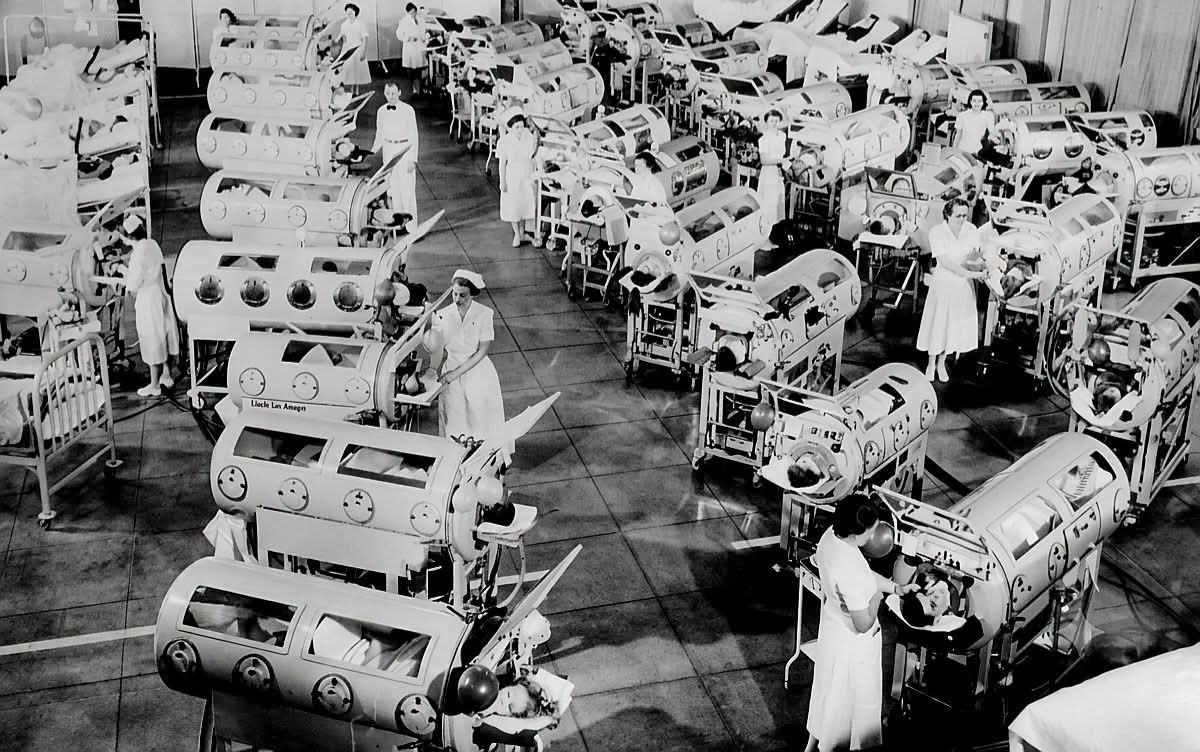 A hospital ward iron lungs caring for polio patients during the mid-20th century, before the widespread use of the polio vaccine.
Life Inside the Machine
For patients, the iron lung was physically confining but often physically welcome. Martha Lillard, who contracted polio at age five in 1953 and spent the rest of her life dependent on the machine, described the experience simply: "At the end of the day when I get in there, it's like a very deep breath" (as cited in NPR, 2021).
Care inside the iron lung was technically complex. Because the patient's body was enclosed, nurses and doctors had access only through small porthole-like openings in the side. Bathing required stopping the machine, sliding the patient out, and completing the task before the patient began to suffocate. Wunsch (2023) described accounts of it taking six people to bathe a single patient in this way. Every routine procedure became an exercise in speed and coordination.
Despite the constraints, patients could spend periods outside the machine during the day as their condition permitted, returning for sleep and whenever fatigue made independent breathing impossible. Some patients eventually recovered enough respiratory function to leave the iron lung permanently. Others did not.
---
The 1952 Copenhagen Crisis
The most consequential moment in the history of mechanical ventilation came not from the iron lung's success, but from its limits.
In the summer of 1952, Copenhagen experienced one of its worst polio outbreaks. The Blegdams Hospital, the city's designated infectious disease facility, was overwhelmed. More than 300 patients developed respiratory paralysis within a matter of weeks, and the hospital did not have enough iron lungs. Mortality among patients with the most severe form of the disease reached 87% (American Journal of Managed Care [AJMC], 2026).
Bjorn Ibsen, a Danish anesthesiologist, proposed a radical alternative. Drawing on techniques from the operating theater, Ibsen suggested performing a tracheostomy on affected patients and manually pumping air directly into the lungs through the opening. This was positive pressure ventilation, the opposite of the iron lung's approach, and it was controversial (AJMC, 2026; Smithsonian Magazine, 2020).
Ibsen was given the chance to demonstrate his method on a young girl named Vivi Ebert who was near death. The procedure succeeded, and she survived (National Institutes of Health [NIH], 2024). But the hospital had no mechanical devices capable of delivering sustained positive pressure ventilation. There were only a handful of such machines in the entire world.
The solution was extraordinary. The hospital recruited over 1,000 medical and dental students to sit beside patients around the clock, manually squeezing rubber bags attached to tracheostomy tubes to keep patients breathing (West, 2005; AJMC, 2026). Shifts lasted eight hours. The students worked in a ward where the disease itself was contagious. Some patients were ventilated manually in this way for weeks.
The mortality rate dropped dramatically. And in December 1953, Ibsen established what is now recognized as the first intensive care unit in Europe at the Kommunehospitalet in Copenhagen (University of Florida Health, 2011). Engineers and physicians, drawing on wartime research into oxygen systems for aircraft pilots, began building the first generation of mechanical positive-pressure ventilators. The iron lung had not failed exactly, but it had revealed its ceiling, and that revelation gave birth to modern critical care medicine.
---
The Vaccine and the Long Decline
In 1955, Jonas Salk's inactivated polio vaccine was approved for use in the United States, and mass vaccination campaigns began almost immediately. Millions of children received the vaccine within the first year. The dramatic reduction in polio cases that followed also reduced the need for iron lungs at almost the same pace (CDC, as cited in NPR, 2021). The last iron lungs were manufactured in the late 1960s (NPR, 2021). By then, positive-pressure ventilators were becoming standard in hospitals, and the negative-pressure machine was already being treated as a relic.
But for the patients already inside the machines, the invention of the vaccine arrived too late. Polio had already done its damage. Some survivors had recovered partial function and could leave the iron lung for much of the day. Others remained dependent on it for the rest of their lives.
---
The Last Iron Lungs
In 2013, an organization called Post-Polio Health International estimated that between six and eight people in the United States were still using iron lungs (Gizmodo, 2017). By 2017, the last known iron lung user in the United Kingdom had died (Vocal Media, n.d.).
Paul Alexander, a Texas lawyer who contracted polio at age six in 1952, taught himself to breathe independently for short periods using a technique called glossopharyngeal breathing, attended college and law school, and practiced law from his wheelchair. He wrote a memoir about his life, titled Three Minutes for a Dog, from inside his iron lung, writing using a pen attached to a stick (Vocal Media, n.d.). Alexander died on March 11, 2024.
Martha Lillard, born in 1948 and diagnosed with polio in 1953, became the last known person in the United States still living in an iron lung after Alexander's death. Lillard had lived independently in Oklahoma for decades, painting, keeping dogs, and traveling when health permitted. She had long preferred the iron lung to modern portable ventilators, saying its negative-pressure system allowed her to breathe more naturally and comfortably (News Beyond Detroit, 2026). She married in February 2026. Lillard died in July 2026 at age 78, marking, in the words of those who followed her story, the closing of a rare chapter in American medical history (News Beyond Detroit, 2026).
---
A Machine That Remade Medicine
The iron lung did not disappear without leaving something behind. Almost every aspect of what is now called intensive care medicine traces its origins to the polio wards of the mid-twentieth century. The practice of gathering severely ill patients in specialized units, of monitoring them continuously, and of using machines to sustain life when the body cannot, all emerged directly from the crisis created by polio and the technologies deployed to meet it (AJMC, 2026; Smithsonian Magazine, 2020).
The iron lung itself was, in the view of the Lancet Respiratory Medicine, a pivotal moment in human history, the first time that people could depend on a machine to remain alive (Wunsch, as cited in American Chemical Society [ACS], 2026). That relationship between human life and mechanical life support is now unremarkable. Ventilators appear in nearly every hospital on earth. But the philosophical and ethical weight of that dependence was first felt by the children and young adults sealed inside those steel cylinders, listening to the machine breathe for them, hour after hour, year after year.
---
References
American Chemical Society. (2026, April 24). The iron lung: How a hulking metal tube became the first machine to keep humans alive. https://www.acs.org/pressroom/tiny-matters/the-iron-lung.html
American Journal of Managed Care. (2026). Learning from past innovations to advance ventilation use in respiratory conditions. https://www.ajmc.com/view/learning-from-past-innovations-to-advance-ventilation-use-in-respiratory-conditions
Britannica. (2026, June 10). Iron lung. https://www.britannica.com/science/iron-lung
Discover Magazine. (2023, August 10). What is an iron lung, and how does it work? https://www.discovermagazine.com/what-is-an-iron-lung-and-how-does-it-work-45271
Gizmodo. (2017, November 20). The last of the iron lungs. https://gizmodo.com/the-last-of-the-iron-lungs-1819079169
Harvard Medical School. (n.d.). Lifesaving breath. https://hms.harvard.edu/news/lifesaving-breath
Maxwell, J. H. (1986). The iron lung: Halfway technology or necessary step? The Milbank Quarterly, 64(1), 3–29. https://www.milbank.org/wp-content/uploads/mq/volume-64/issue-01/64-1-The-Iron-Lung.pdf
National Institutes of Health. (2024). Bjørn Ibsen: What made intensive care so critical? PMC. https://pmc.ncbi.nlm.nih.gov/articles/PMC11411485/
News Beyond Detroit. (2026, July 11). Martha Lillard, one of America's last iron lung survivors, dies at 78. https://newsbeyonddetroit.net/2026/07/11/martha-lillard-one-of-americas-last-iron-lung-survivors-dies-at-78/
NPR. (2021, October 25). Decades after polio, Martha is among the last to still rely on an iron lung to breathe. https://www.npr.org/2021/10/25/1047691984/decades-after-polio-martha-is-among-the-last-to-still-rely-on-an-iron-lung-to-br
Science Museum. (n.d.). The iron lung. https://www.sciencemuseum.org.uk/objects-and-stories/medicine/iron-lung
Smithsonian Magazine. (2020, June 10). How a polio outbreak in Copenhagen led to the invention of the ventilator. https://www.smithsonianmag.com/innovation/how-polio-outbreak-copenhagen-led-to-invention-ventilator-180975045/
Uen Press. (2022, February 1). Iron lung. https://uen.pressbooks.pub/ehsl/chapter/iron-lung/
University of Florida Health. (2011, December 16). Treatment of polio led to the evolution of the modern ICU. https://news.drgator.ufl.edu/2011/12/16/treatment-of-polio-led-to-the-evolution-of-the-modern-icu
Vocal Media. (n.d.). Iron lungs and polio: Two people remain in the U.S. that rely on iron lungs to breathe. https://vocal.media/fyi/iron-lungs-and-polio-two-people-remain-in-the-u-s-that-rely-on-iron-lungs-to-breathe
West, J. B. (2005). The physiological challenges of the 1952 Copenhagen poliomyelitis epidemic and a renaissance in clinical respiratory physiology. Journal of Applied Physiology, 99(2), 424–432. https://doi.org/10.1152/japplphysiol.00184.2005
Wunsch, H. (2023). The autumn ghost: How the battle against a polio epidemic revolutionized modern medical care. Celadon Books. (Excerpt adapted via Gavi.org, https://www.gavi.org/vaccineswork/book-excerpt-how-iron-lung-transformed-polio-care)
Comments (0)