
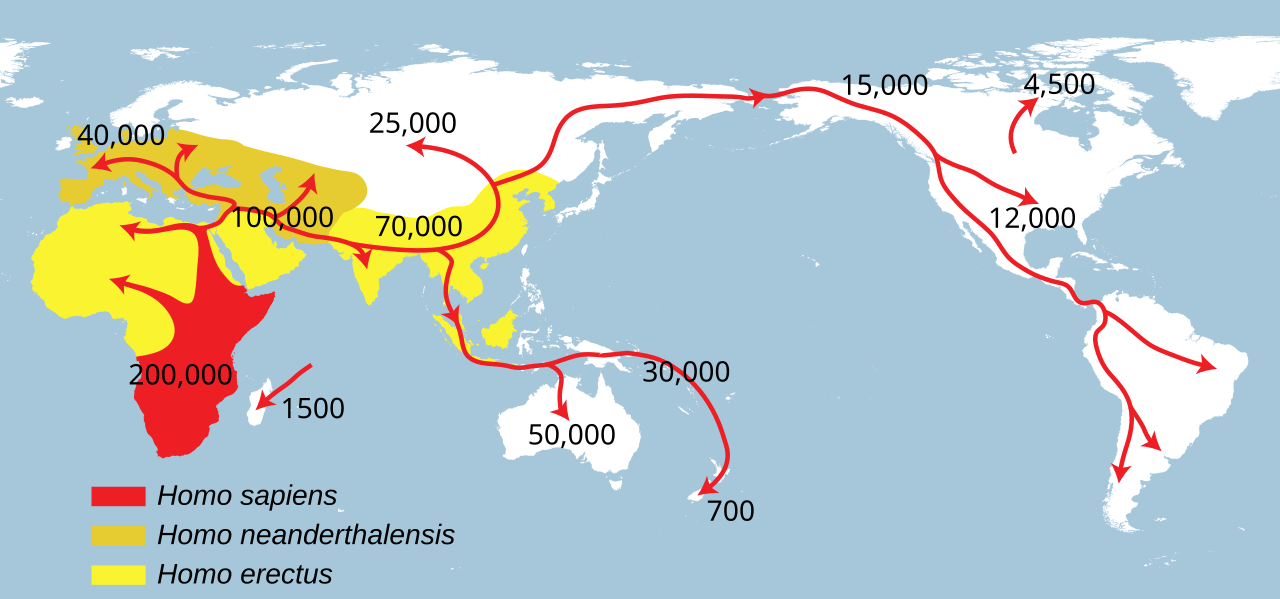
Introduction to Human Origins and the Out of Africa Theory
Overview of Human Origins
Homo sapiens anatomically modern humans occupy a singular position in the history of life on Earth. As the sole surviving member of the genus Homo, our species has demonstrated an unparalleled capacity for behavioural flexibility, symbolic thought, and cumulative cultural evolution. The emergence of Homo sapiens in Africa, broadly dated to between 300,000 and 200,000 years before present (BP), represents not a singular event but a mosaic process unfolding across a geographically diverse continent (Hublin et al., 2017; Scerri et al., 2018).
Human migration the large-scale movement of populations across geographic space is not merely a historical curiosity but a fundamental mechanism through which H. sapiens came to inhabit virtually every terrestrial environment on Earth. Understanding the timing, routes, and drivers of these dispersals is essential to comprehending patterns of genetic diversity, linguistic differentiation, cultural variation, and the demographic structure of contemporary human populations.
The Out of Africa theory (alternatively termed the Recent African Origin model) provides the dominant theoretical framework within which researchers situate and interpret these migratory processes. It posits that all living humans descend from a population that originated in sub Saharan Africa and subsequently spread across the globe, largely replacing though, as more recent evidence demonstrates, also partially interbreeding with archaic hominin populations encountered along the way.
The Out of Africa Theory
The intellectual genealogy of the Out of Africa hypothesis extends to the late nineteenth century, when Charles Darwin, in The Descent of Man (1871), speculated that Africa was the most probable cradle of humankind given the continent's wealth of extant great apes. However, the theory was not placed on a rigorous empirical footing until the latter decades of the twentieth century.
The seminal contribution of Cann, Stoneking, and Wilson (1987), published in Nature, demonstrated through mitochondrial DNA (mtDNA) analysis that all modern human mtDNA lineages coalesce in a single African ancestor popularly termed "Mitochondrial Eve" dated to approximately 200,000 years BP. This finding was subsequently corroborated and refined through Y-chromosome phylogenies (Underhill et al., 2000) and, most powerfully, by whole-genome sequencing studies that confirm Africa harbours greater genetic diversity than any other region of the world a hallmark of a species' geographic point of origin (Tishkoff et al., 2009).
The fossil record offers complementary support. The Jebel Irhoud specimens from Morocco, redated by Hublin et al. (2017) to approximately 315,000 years BP using thermoluminescence, exhibit a mosaic of modern and archaic cranial features consistent with an early, pan-African phase of H. sapiens evolution. Earlier finds from Omo Kibish, Ethiopia (Omo I and II, ~195,000 BP) and Herto, Ethiopia (~160,000 BP) further anchor anatomically modern morphology in Africa prior to any credible evidence of H. sapiens outside the continent.
Alternative frameworks most notably the Multiregional Continuity hypothesis (Wolpoff et al., 1988), which proposes that modern humans evolved in parallel across Africa, Europe, and Asia through gene flow among regional populations of Homo erectus have been substantially undermined by genomic data. While the discovery of archaic introgression (discussed below) has necessitated a more nuanced model than strict replacement, the overwhelming weight of molecular and fossil evidence sustains Africa as the primary and recent source of modern human ancestry.
Environmental and Climatic Factors Encouraging Migration
Role of Environmental Changes
The Pleistocene epoch (2.58 million–11,700 years BP) was characterised by pronounced glacial interglacial oscillations driven by Milankovitch cycles periodic variations in Earth's orbital parameters that modulated solar insolation. These climatic fluctuations had profound consequences for African and Eurasian landscapes, alternately expanding and contracting habitable zones, altering sea levels, and reshaping hydrological networks.
During glacial maxima, increased aridity in sub-Saharan Africa fragmented forest and savannah environments, creating refugia in which human populations became isolated a process thought to have accelerated genetic differentiation (Eriksson et al., 2012). Conversely, humid interglacial periods greened the Sahara and the Arabian Peninsula, opening dispersal corridors that had previously been impassable. The African Humid Period, or "Green Sahara," occurring approximately 130,000–115,000 BP and again ~11,000–5,000 BP, is particularly significant: palaeolake records, fossil pollen assemblages, and fluvial deposits attest to a dramatically wetter North Africa that would have facilitated northward population movement (Drake et al., 2011).
Sea level changes associated with glacial cycles further altered the geographic template of migration. During glacial maxima, global sea levels fell by up to 120 metres relative to present, exposing continental shelves and creating land bridges most notably Sundaland in Southeast Asia and Beringia connecting Siberia to North America that were critical conduits for human dispersal.
Adaptation to New Environments
The ecological versatility of H. sapiens distinguishes it from earlier hominins. Whereas H. erectus and the Neanderthals occupied relatively stable ecological niches, modern humans demonstrated a remarkable capacity to exploit novel environments through a combination of biological plasticity, technological innovation, and social learning.
Technologically, the Middle Stone Age (MSA) of Africa (ca. 280,000–25,000 BP) witnessed the development of composite tools, hafting technology, the use of ochre for symbolic purposes, and early evidence of long-distance exchange networks all indicative of an increasingly complex behavioural repertoire (Henshilwood & Marean, 2003). The Later Stone Age and its Eurasian equivalent, the Upper Palaeolithic, saw further elaboration of lithic technologies alongside the emergence of representational art, personal ornaments, and evidence of structured spatial organisation at occupation sites.
Cultural evolution the cumulative transmission and modification of learned behaviours across generations enabled human groups to develop ecologically specific subsistence strategies with a rapidity that biological evolution alone could not achieve. The exploitation of marine resources along the southern African coast (Marean et al., 2007) and the tailoring of cold-climate clothing inferred from the presence of eyed needles at Siberian sites exemplify this adaptive capacity.
Major Migration Routes
Migration into the Middle East and Asia
The precise number and timing of out of Africa dispersal events remains a matter of active scholarly debate. There is robust evidence for at least one major dispersal beginning approximately 60,000–70,000 years BP, with some researchers advocating for earlier, partially successful exits around 120,000 BP (e.g., the Qafzeh and Skhul hominins in the Levant) and potentially 200,000 BP (the Misliya Cave maxilla, Israel; Hershkovitz et al., 2018).
The primary dispersal routes from Africa into Eurasia traversed either the Sinai Peninsula (the "Northern Route") or the Bab-el-Mandeb Strait at the mouth of the Red Sea (the "Southern Route"), where reduced Pleistocene sea levels may have permitted crossing on foot or via rudimentary watercraft. Once in the Levant, populations expanded eastward through the Iranian Plateau and Central Asia, or followed coastal margins around the Indian Ocean rim the "coastal highway" hypothesis supported by genetic evidence (Macaulay et al., 2005).
Key archaeological sites bearing early evidence of H. sapiens in Asia include Madjedbebe, Australia (discussed below), and sites in China such as Fuyan Cave (Hunan Province), where modern human teeth dated to ~80,000–120,000 BP have been recovered (Liu et al., 2015) a finding that, if confirmed, significantly antedates the canonical dispersal timeline and implies multiple waves of migration.
Migration into Europe
Europe was colonised by anatomically modern humans beginning approximately 45,000–42,000 years BP, as evidenced by the Bacho Kiro Cave assemblage in Bulgaria and the early Aurignacian cultural horizon distributed across the continent (Fewlass et al., 2020). Entry was likely achieved via multiple routes: the Levantine corridor through Anatolia and the Balkans, and possibly a northern route through the Caucasus.
The European archaeological record is particularly rich, encompassing iconic sites such as Chauvet Cave (France, ~36,000 BP), with its elaborate painted fauna, and Hohle Fels (Germany), which has yielded some of the earliest known figurative art and musical instruments. These discoveries attest to the fully modern cognitive and symbolic capacities of early European H. sapiens.
Europe is also the geographical theatre for the most extensively documented interaction between H. sapiens and another hominin species: the Neanderthals (Homo neanderthalensis). The temporal overlap between modern humans and Neanderthals in Europe estimated at several thousand years raises questions about the nature of their coexistence, competition, and interbreeding, addressed in detail in Section E.
Migration into Australia and the Americas
The colonisation of Sahul (the combined landmass of Australia, New Guinea, and Tasmania during periods of lower sea level) required open-water crossings of at least 90 kilometres even at glacial maxima, implying the use of watercraft and representing a remarkable feat of maritime navigation. The Madjedbebe rock shelter in Australia's Northern Territory has yielded dates of approximately 65,000 BP, which, if accepted, constitutes the earliest evidence of H. sapiens outside Africa and the Middle East (Clarkson et al., 2017). More conservative estimates place the colonisation of Sahul at 50,000–47,000 BP.
The peopling of the Americas presents a more complex picture. The traditional "Clovis First" model, which proposed entry via the Bering Land Bridge approximately 13,000 years BP and rapid southward dispersal by Clovis-culture hunters, has been substantially challenged by accumulating pre-Clovis evidence. Sites such as Monte Verde (Chile, ~14,500 BP) and Chiquihuite Cave (Mexico, ~26,000 BP; Ardelean et al., 2020) suggest human presence in the Americas significantly predating the Clovis horizon. Genetic studies support multiple migration waves, including distinct contributions from Siberian, East Asian, and potentially Australasian source populations (Skoglund & Reich, 2016).
The arrival of humans in previously uninhabited landmasses was frequently associated with pronounced megafaunal extinctions a pattern documented in Australia, the Americas, and later on Pacific islands though the relative contributions of human hunting, climatic change, and their interactions remain contested (Koch & Barnosky, 2006).
Archaeological Discoveries and Genetic Studies
Archaeological Evidence
The material record of prehistoric human migration has been transformed by methodological advances in the past three decades. Optically stimulated luminescence (OSL) and accelerator mass spectrometry (AMS) radiocarbon dating have dramatically improved the precision and temporal reach of chronologies, while micro-archaeological techniques including phytolith analysis, lipid residue studies, and micromorphology extract behavioural information from sediments at previously inaccessible scales.
Among the most consequential recent discoveries are the Homo naledi remains from the Rising Star Cave system, South Africa, dated to 335,000–236,000 BP (Dirks et al., 2017), which complicate narratives of a linear progression toward modern human morphology. The Nesher Ramla hominin from Israel (~120,000 BP), exhibiting a mosaic of Neanderthal and archaic features (Hershkovitz et al., 2021), similarly attests to the complex, reticulate evolutionary history of the genus Homo in the Middle Pleistocene.
Remote sensing technologies including LiDAR survey, satellite imagery analysis, and drone based photogrammetry are increasingly deployed to identify previously unknown archaeological sites across vast and difficult terrain, expanding the geographic scope of migration research beyond the historically well studied regions of Europe and the Levant.
Genetic Studies
The advent of ancient DNA (aDNA) analysis has constituted a revolution in our understanding of human prehistory, enabling direct inference of ancestry, relatedness, and admixture from skeletal remains spanning tens of thousands of years. The sequencing of the Neanderthal genome (Green et al., 2010) and the Denisovan genome (Reich et al., 2010) by the Max Planck Institute for Evolutionary Anthropology established beyond doubt that H. sapiens interbred with both species, with consequences for the genomic composition of living humans.
Population genomic studies of contemporary diversity, pioneered by researchers including Sarah Tishkoff, David Reich, and Eske Willerslev, have delineated major migration events, population bottlenecks, and episodes of admixture with unprecedented resolution. The SGDP (Simons Genome Diversity Project) and HGDP (Human Genome Diversity Project) datasets have been particularly valuable in this regard. Notably, present day African populations harbour deep lineages not found in any out-of-Africa population, confirming Africa as the cradle of modern human diversity (Bergström et al., 2020).
The application of Bayesian phylogenetic modelling to linguistic, genetic, and archaeological data simultaneously a growing field sometimes termed "phylogenomics of human prehistory" promises further integration of disparate evidence streams in reconstructing migration histories.
Interactions with Other Hominins
Neanderthals and Denisovans
The relationship between H. sapiens and the Neanderthals has undergone a dramatic reassessment in the genomic era. Rather than a story of simple replacement, the evidence now supports a model of protracted contact and interbreeding. Non-African modern humans carry, on average, approximately 1–4% Neanderthal derived DNA (Prüfer et al., 2014), acquired through admixture events primarily in the Middle East and possibly in Europe. This introgressed genetic material is not evenly distributed across the genome; certain Neanderthal alleles appear to have been adaptive in modern human populations notably those associated with immune function (Dannemann & Kelso, 2017) and skin or hair pigmentation while others have been subject to negative selection, particularly in regions implicated in male fertility and brain development.
The Denisovans, known primarily from fragmentary skeletal material recovered from Denisova Cave in the Altai Mountains, Siberia, contributed genetic material to the ancestors of present day Melanesians, Aboriginal Australians, and some South and Southeast Asian populations, who carry up to ~5% Denisovan ancestry (Reich et al., 2010). The EPAS1 gene variant conferring altitude adaptation in Tibetan populations has been identified as a Denisovan introgression (Huerta-Sánchez et al., 2014), providing perhaps the most vivid example of adaptive introgression from archaic hominins in the modern human lineage.
Other Hominin Species
Beyond Neanderthals and Denisovans, genomic analysis of African populations has detected signatures of introgression from as yet unidentified archaic lineages that diverged from the H. sapiens stem lineage over 500,000 years ago (Hammer et al., 2011). These "ghost lineages" likely correspond to morphologically distinct populations whose skeletal remains have not yet been confidently associated with their genomic signal.
The discovery of Homo floresiensis on the island of Flores, Indonesia (Brown et al., 2004), and of Homo luzonensis in the Philippines (Détroit et al., 2019) demonstrates that Southeast Asian archipelagos harboured diverse hominin populations during the Pleistocene some of which may have overlapped temporally with incoming H. sapiens. The extent of any interaction or genetic exchange between these insular populations and early modern humans remains to be established.
Scholarly Debates and Implications
Migration Timelines and Routes
The reconstruction of human dispersal timelines is complicated by several methodological challenges: taphonomic biases in the preservation and discovery of fossil and archaeological materials; the imprecision of dating methods at the outer limits of their applicability; and the interpretive ambiguity of "anatomical modernity" as a taxonomic criterion. The identification of a specimen as H. sapiens on the basis of incomplete or fragmentary material is inherently probabilistic.
The "single dispersal" versus "multiple dispersal" debate exemplifies the interpretive challenges of the field. While the genetic evidence for a primary out of Africa dispersal approximately 60,000 BP is robust, the presence of morphologically modern or near-modern specimens in the Levant (~120,000 BP) and southern China (~80,000–120,000 BP) suggests earlier, perhaps smaller scale population movements whose descendants may have largely been absorbed or replaced by later dispersing groups. Reconciling the fossil and genetic records in a coherent chronological framework remains an active area of inquiry.
The so called "Southern Dispersal" hypothesis, which proposes rapid coastal migration from East Africa through South Asia to Southeast Asia and Sahul, is supported by genetic evidence of deep lineages in Andaman Islander and Aboriginal Australian populations, but the predicted coastal archaeological sites have been largely submerged by post-glacial sea-level rise, severely limiting direct material evidence.
Understanding Human Evolution and Global Population History
Migration studies have fundamentally reshaped our understanding of human evolution as a reticulate rather than a linear process. The traditional "family tree" metaphor has given way to a more complex "braided stream" model (Templeton, 2002), in which multiple lineages periodically merge through admixture before diverging again. The boundaries between H. sapiens and archaic hominins were evidently more porous than previously assumed, with significant genetic exchange occurring at multiple points in time and space.
The implications extend to contemporary human diversity. Patterns of genetic variation, disease susceptibility, and pharmacogenomic response in living populations are in part products of ancient migration histories and archaic introgression events. A complete understanding of human health and population biology therefore requires a deep temporal perspective grounded in paleoanthropological research.
Looking forward, the continued refinement of ancient genomics particularly the recovery and sequencing of aDNA from tropical environments where DNA preservation has historically been poor holds considerable promise. The development of population genomic simulators capable of modelling complex demographic histories, combined with machine learning approaches to pattern recognition in large genomic datasets, will likely yield new insights into the timing, scale, and routes of human dispersal in the coming decade
Conclusion
Summary of Key Findings
This article has traced the emergence of Homo sapiens in Africa and their subsequent dispersal across the globe, drawing on converging lines of fossil, archaeological, and genomic evidence. The Out of Africa theory, substantially supported by mitochondrial and nuclear DNA studies, places the origin of modern human ancestry in Africa no later than 300,000 years BP, with a primary dispersal event colonising Eurasia approximately 60,000–70,000 years BP. Environmental fluctuations during the Pleistocene particularly the greening of otherwise arid dispersal corridors appear to have been permissive, if not causally decisive, for these movements.
Early H. sapiens populations demonstrated remarkable ecological flexibility, facilitated by cumulative cultural evolution and technological innovation. Their trajectories carried them into the Middle East, Central and East Asia, Europe, Sahul, and ultimately the Americas a process spanning tens of thousands of years and resulting in the colonisation of every habitable continent. Crucially, this expansion was not a simple replacement of pre-existing hominin populations; gene flow between H. sapiens and Neanderthals, Denisovans, and possibly other archaic lineages has left a discernible imprint on the genomes of living humans, with some introgressed variants having demonstrably adaptive value.
Future Research Directions
Several critical lacunae remain in the current account of human migration. The pre-60,000 BP dispersal events evidenced by fossil material in the Levant and East Asia remain poorly understood in terms of their demographic scale, geographic extent, and ultimate fate. The submerged coastal landscapes that would have been traversed by populations following the Southern Dispersal route represent a largely inaccessible archive requiring innovative approaches in underwater archaeology.
The improvement of aDNA extraction from tropical skeletal material where warm, humid conditions degrade nucleic acids rapidly would transform our understanding of human prehistory in South Asia, sub-Saharan Africa, and Southeast Asia, regions that were geographically central to dispersal but are currently genomically underrepresented in ancient datasets. Advances in protein analysis (palaeoproteomics) offer a partial solution, as proteins survive in skeletal material far longer than DNA.
Interdisciplinary integration will be essential. The synthesis of palaeoclimatological modelling, agent based simulation of population dynamics, isotopic analysis of mobility patterns, and high resolution ancient genomics offers a methodological programme commensurate with the complexity of the phenomena under investigation. As this programme advances, the story of how a single African lineage came to inhabit the world will continue to be told with ever greater precision and nuance.
References
Ardelean, Ciprian F., et al. 2020. “Evidence of Human Occupation in Mexico around the Last Glacial Maximum.” Nature 584: 87–92.
Bergström, Anders, et al. 2020. “Insights into Human Genetic Variation and Population History from 929 Diverse Genomes.” Science 367: eaay5012.
Brown, Peter, et al. 2004. “A New Small-Bodied Hominin from the Late Pleistocene of Flores, Indonesia.” Nature 431: 1055–1061.
Cann, Rebecca L., Mark Stoneking, and Allan C. Wilson. 1987. “Mitochondrial DNA and Human Evolution.” Nature 325: 31–36.
Clarkson, Chris, et al. 2017. “Human Occupation of Northern Australia by 65,000 Years Ago.” Nature 547: 306–310.
Dannemann, Michael, and Janet Kelso. 2017. “The Contribution of Neanderthals to Phenotypic Variation in Modern Humans.” American Journal of Human Genetics 101: 578–589.
Détroit, Florent, et al. 2019. “A New Species of Homo from the Late Pleistocene of the Philippines.” Nature 568: 181–186.
Dirks, Paul H. G. M., et al. 2017. “The Age of Homo naledi and Associated Sediments in the Rising Star Cave, South Africa.” eLife 6: e24231.
Drake, Nick A., et al. 2011. “Ancient Watercourses and Biogeography of the Sahara Explain the Peopling of the Desert.” Proceedings of the National Academy of Sciences 108: 458–462.
Eriksson, Anders, et al. 2012. “Late Pleistocene Climate Change and the Global Expansion of Anatomically Modern Humans.” Proceedings of the National Academy of Sciences 109: 16089–16094.
Fewlass, Helen, et al. 2020. “A 14C Chronology for the Middle to Upper Palaeolithic Transition at Bacho Kiro Cave, Bulgaria.” Nature Ecology & Evolution 4: 794–801.
Green, Richard E., et al. 2010. “A Draft Sequence of the Neandertal Genome.” Science 328: 710–722.
Hammer, Michael F., et al. 2011. “Genetic Evidence for Archaic Admixture in Africa.” Proceedings of the National Academy of Sciences 108: 15123–15128.
Henshilwood, Christopher S., and Curtis W. Marean. 2003. “The Origin of Modern Human Behavior.” Current Anthropology 44: 627–651.
Hershkovitz, Israel, et al. 2018. “The Earliest Modern Humans Outside Africa.” Science 359: 456–459.
Hershkovitz, Israel, et al. 2021. “A Middle Pleistocene Homo from Nesher Ramla, Israel.” Science 372: 1424–1428.
Hublin, Jean-Jacques, et al. 2017. “New Fossils from Jebel Irhoud, Morocco and the Pan-African Origin of Homo sapiens.” Nature 546: 289–292.
Huerta-Sánchez, Emilia, et al. 2014. “Altitude Adaptation in Tibetans Caused by Introgression of Denisovan-Like DNA.” Nature 512: 194–197.
Koch, Paul L., and Anthony D. Barnosky. 2006. “Late Quaternary Extinctions: State of the Debate.” Annual Review of Ecology, Evolution, and Systematics 37: 215–250.
Liu, Wu, et al. 2015. “The Earliest Unequivocally Modern Humans in Southern China.” Nature 526: 696–699.
Macaulay, Vincent, et al. 2005. “Single, Rapid Coastal Settlement of Asia Revealed by Analysis of Complete Mitochondrial Genomes.” Science 308: 1034–1036.
Marean, Curtis W., et al. 2007. “Early Human Use of Marine Resources and Pigment in South Africa during the Middle Pleistocene.” Nature 449: 905–908.
Prüfer, Kay, et al. 2014. “The Complete Genome Sequence of a Neanderthal from the Altai Mountains.” Nature 505: 43–49.
Reich, David, et al. 2010. “Genetic History of an Archaic Hominin Group from Denisova Cave in Siberia.” Nature 468: 1053–1060.
Scerri, Eleanor M. L., et al. 2018. “Did Our Species Evolve in Subdivided Populations across Africa, and Why Does It Matter?” Trends in Ecology & Evolution 33: 582–594.
Skoglund, Pontus, and David Reich. 2016. “A Genomic View of the Peopling of the Americas.” Current Opinion in Genetics & Development 41: 27–35.
Templeton, Alan R. 2002. “Out of Africa Again and Again.” Nature 416: 45–51.
Tishkoff, Sarah A., et al. 2009. “The Genetic Structure and History of Africans and African Americans.” Science 324: 1035–1044.
Underhill, Peter A., et al. 2000. “Y Chromosome Sequence Variation and the History of Human Populations.” Nature Genetics 26: 358–361.
Wolpoff, Milford H., Wu Xinzhi, and Alan G. Thorne. 1988. “Modern Homo sapiens Origins: A General Theory of Hominid Evolution Involving the Fossil Evidence from East Asia.” In The Origins of Modern Humans: A World Survey of the Fossil Evidence, edited by Fred H. Smith and Frank Spencer, 411–483. New York: Alan R. Liss.
Image courtesy: NordNordWest, Public domain, via Wikimedia Commons
Comments (0)