
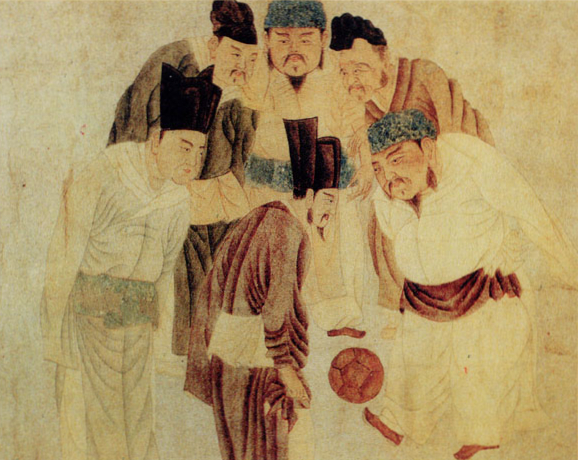
 Emperor Taizu of Song playing cuju (Chinese football) with his prime minister Zhao Pu (趙普) and other ministers, by Yuan dynasty artist Qian Xuan (1235–1305)
More than four billion people around the world identify as football fans (Giesbert, 2020). Stadiums fill with tens of thousands of supporters every weekend. National team matches can pause wars and topple governments. The World Cup final attracts a global television audience larger than any other recurring event in human history. Yet the version of the game most people watch today, eleven players on each side, a round ball, and a set of carefully maintained rules, is only about 160 years old. The deeper story of football is far longer, far messier, and far more interesting.
This article tells that story in four broad movements. It begins in the ancient world, where early civilizations across Asia, Europe, and the Americas played ball games that bear a recognizable family resemblance to football. It then moves to medieval Britain, where unruly folk games laid social and cultural foundations for the sport. The third section examines the decisive nineteenth-century moment when clubs, schools, and governing bodies hammered out a common rulebook and transformed football into an organized competition. The final section traces football's remarkable global spread through colonialism, migration, and eventually mass media, culminating in the planetary institution we know today.
2. Ancient Antecedents: Kicking a Ball Across the Ancient World
2.1 Cuju: The Earliest Recorded Kicking Game
The earliest documented evidence of a game played primarily with the feet comes from China. Known as cuju, which translates roughly as "kick ball," the game originated during the Han Dynasty, around the second century BCE (Englishmadesimple.org, 2025). Historical records indicate that players used any part of the body except the hands to propel a leather ball through a small net or opening. These accounts describe cuju not simply as recreation but as a method of military training and an imperial pastime (Englishmadesimple.org, 2025). FIFA, the international governing body of the sport, has formally recognized cuju as the earliest form of a kicking game for which historical evidence survives (History.com, 2024).
The significance of cuju lies in what it tells us about human nature as much as about sport. Across many cultures and centuries, the impulse to kick an object toward a target seems to arise independently. This suggests that football, in its most basic form, is less an invention than a discovery.
2.2 Episkyros and Harpastum: Ball Games of Greece and Rome
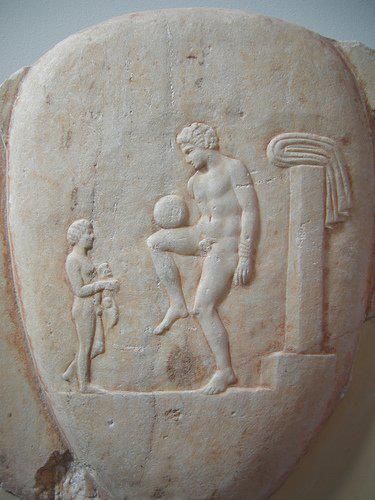
In ancient Greece, a game called episkyros was played between two teams, with players permitted to use both hands and feet. Contemporary accounts describe it as physically demanding and tactically demanding, resembling a hybrid of what we would today call rugby and football (ITK Magazine, 2024). The Romans encountered episkyros through their contact with Greek culture and developed their own version, called harpastum, which involved controlling and kicking a small, hard ball while avoiding the tackles of opponents (ITK Magazine, 2024).
When Roman legions invaded Britain in the first century CE, they brought harpastum with them. However, scholars note that evidence of organized ball play in Britain only began to emerge after the Romans departed in the early fifth century CE (These Football Times, 2019). Whatever Roman influence existed did not transplant neatly onto British soil. Instead, something rougher and more distinctly local took its place.
3. Mob Football: The Chaotic Medieval Precursor
3.1 A Game Without Rules
For most of the medieval period in Britain and across Europe, "football" was not a single game but a loose family of violent communal contests. Historians group these under the general label of mob football, a term that captures both the scale of participation, sometimes involving hundreds of players at once, and the essential chaos of play (These Football Times, 2019).
Mob football was typically played between neighboring villages on festival days, most commonly Shrove Tuesday. There were no fixed numbers of players, no defined pitch, and minimal restrictions on physical contact. In one common variant, Shrovetide football, the object was simply to move a ball, often an inflated pig's bladder, to the opposing village's church or market square (These Football Times, 2019). Matches could cover miles of open countryside and last for hours, spilling through streets and fields alike.
3.2 Bans, Persistence, and Cultural Meaning
The violence of mob football alarmed authorities almost from the beginning. Multiple English monarchs, including Edward II, Edward III, and Henry V, issued proclamations attempting to suppress the game, partly on the grounds that it distracted men from the archery practice needed for military service (ITK Magazine, 2024). Similar bans were enacted in Scotland and France. None of them worked for long.
The persistence of mob football in the face of repeated prohibition tells us something important. The game was not merely entertainment. It was woven into the social fabric of community life, bound up with local identity, seasonal ritual, and a sanctioned outlet for the tensions that existed between neighboring groups. Suppressing it was less like banning a sport and more like banning a festival. Some forms of Shrovetide football, remarkably, still survive in English towns today.
4. The Public Schools and the Birth of Modern Football
4.1 Football Moves Indoors and Upstairs
By the early nineteenth century, football began to move out of the village commons and into a very different social environment: the elite boarding schools of England. Institutions such as Eton, Harrow, Rugby, and Winchester took up various forms of the game, but each developed its own idiosyncratic version. Some allowed carrying the ball; others did not. Some permitted hacking, the practice of kicking opponents in the shins; others banned it. These divergent codes were a direct obstacle to organized competition, since two teams from different schools could not easily agree on how to play.
The public school context also changed what the game was for. Rather than a seasonal communal release, football became a tool of character formation. School administrators promoted sport as a means of building discipline, teamwork, and a sense of fair play, values that the Victorian establishment associated with the idealized English gentleman. This ideology, often called "muscular Christianity," gave respectable institutional backing to a game that had previously been associated with peasant rowdiness.
4.2 Cambridge and the Push Toward Unification
The first serious attempt to create a unified set of rules came not from a governing body but from students. At Cambridge University in the 1840s, undergraduates who had come from different schools and wanted to play together drafted an early common code (Cambridge University Library Special Collections, 2013). Although these rules were still relatively limited and retained some elements that later disappeared, such as the ability to catch the ball, they represented the first deliberate effort to bring the divergent traditions of English football under one framework.
A surviving version of the Cambridge Rules from 1856 is held at the Cambridge University Library, making it one of the oldest documentary artifacts of organized football (Cambridge University Library Special Collections, 2013). The principles embedded in that document, clear boundaries, agreed scoring methods, restrictions on physical violence, would flow directly into the landmark meeting of 1863.
5. 1863: The Year Football Was Born
5.1 The Freemasons' Tavern Meetings
On October 26, 1863, representatives of a dozen London football clubs gathered at the Freemasons' Tavern in the city's Great Queen Street. Their stated purpose was "to form an Association with the object of establishing a definite code of rules for the regulation of the game" (Cambridge University Library Special Collections, 2013). Over five further meetings across the following weeks, they debated, argued, and eventually voted on a shared rulebook.
The central controversy was whether to permit two practices that had divided English football for decades: catching the ball and hacking. A club called Blackheath strongly advocated for hacking, arguing that removing it would undermine the physical toughness of the game and produce "a game for weaklings" (Laws of the Game History, n.d.). The majority disagreed. When hacking was banned, Blackheath walked out and later became a founding member of the Rugby Football Union, thus cementing the split between what would become association football and rugby that persists to this day.
The eleven remaining clubs ratified a set of fourteen laws under the authorship of Ebenezer Cobb Morley, a solicitor who would serve as the Football Association's first secretary (Laws of the Game History, n.d.). These laws defined pitch dimensions, established that goals should consist of two upright posts without a crossbar, and banned both carrying the ball and hacking. The Football Association (the FA) was thereby formally established, making it the world's first governing body for the sport.
5.2 Sheffield and the Parallel Tradition
It is worth noting that the FA's laws were not immediately adopted everywhere. Sheffield Football Club had written its own code in 1858, and the Sheffield Association ran competitions under their own rules through the 1860s and into the 1870s (National Football Museum, 2026). The world's first organized football tournament, the Youdan Cup, was played under Sheffield Rules in 1867 (National Football Museum, 2026). It was not until 1877 that Sheffield finally adopted the FA code, bringing the two principal English traditions into alignment.
This brief period of competing codes is a reminder that the "birth" of football in 1863 was not a sudden, clean event. It was the beginning of a long negotiation, a process of standardization that took years and required continuous compromise.
5.3 The Laws of the Game and Their Legacy
The 1863 laws were strikingly brief and provisional compared to the detailed rulebooks that govern football today. There was no mention of a goalkeeper as a distinct role, no penalty kick (which was not introduced until 1891), and no crossbar on the goals. Yet the underlying logic of the game was in place: two teams, a defined space, a ball to be moved by foot, and a prohibition on using the hands (Laws of the Game History, n.d.).
The laws were revised regularly over the following decades. In 1882, the four British football associations, England, Scotland, Wales, and Northern Ireland, unified their rules and formed the International Football Association Board (IFAB) to oversee any future changes (Laws of the Game History, n.d.). The IFAB remains the sole authority responsible for amending the Laws of the Game to this day, a remarkable continuity across more than 140 years.
6. Professionalism and the Football League
6.1 Class, Money, and the Amateur Ideal
For the first two decades of its existence, the FA was dominated by a southern English, middle-class, amateur ethos. Players were expected to compete for pride, not payment. This arrangement suited clubs whose members were drawn from the professional and merchant classes, men who could afford to play for free. It sat very uneasily with the realities of industrial northern England.
In the mill towns and mining communities of Lancashire and the Midlands, football was rapidly becoming the working man's sport. Working-class players could not afford to take time off work without compensation. They could not travel to away fixtures without their expenses covered. The prohibition on payment was, in practice, a mechanism that reinforced social class: it kept the game safe for gentlemen and put it out of reach for the laboring majority (Britannica, 2024).
Clubs in northern England responded by simply ignoring the rule. Illegal payments to players became so widespread that the FA faced an embarrassing contradiction between its stated policy and the actual practice of the clubs it was supposed to govern (Britannica, 2024). In 1884, the FA expelled two clubs for using professional players. But with violations everywhere, expulsion was not a credible deterrent.
6.2 Legalization and the Rise of the Football League
In 1885, the FA capitulated. Professionalism was officially legalized, subject to certain residency requirements (The 1888 Letter, 2023). The immediate consequence was a transformation of the club landscape. With wages now permitted, northern clubs could recruit the best players openly, build larger supporter bases, and generate revenue from gate receipts. The social character of football shifted. As the influence of working-class players rose, the upper classes largely retreated to other sports, notably cricket and rugby union (Britannica, 2024).
Three years later, in 1888, a Scottish draper and Aston Villa director named William McGregor identified the next structural problem: without regular, guaranteed fixtures, clubs could not plan their finances or attract consistent crowds. Friendly matches could be cancelled at short notice. Cup competitions ended early for most clubs. McGregor proposed a league format in which a fixed set of clubs would play each other home and away across a season, guaranteeing both revenue and competition (Grokipedia, 2026).
The Football League was founded on April 17, 1888, at the Royal Hotel in Manchester (Grokipedia, 2026). Its twelve founding members were drawn from the northern and Midland clubs that had driven professionalism: Accrington, Aston Villa, Blackburn Rovers, Bolton Wanderers, Burnley, Derby County, Everton, Notts County, Preston North End, Stoke, West Bromwich Albion, and Wolverhampton Wanderers. Average attendance in England rose from 4,600 in 1888 to 13,200 by 1905, and reached 23,100 at the outbreak of the First World War (Britannica, 2024). The league model proved so effective that it became the template for organized football competition around the world.
7. Football Goes Global
7.1 The Role of British Expansion
Football did not stay in England for long. The sport traveled with the British people, carried by sailors, merchants, soldiers, engineers, and missionaries to virtually every corner of the world in the latter half of the nineteenth century. In some places this diffusion was explicitly linked to the mechanisms of British imperial power. In others it was more informal, spreading through trading ports and railroad construction crews.
South America received the game very early. In Buenos Aires, Argentina, European sailors were playing football as early as the 1860s, and members of the British expatriate community founded the Buenos Aires Football Club in 1867 (Britannica, 2024). The first Argentinian league championship was played in 1893, though most participants at that stage still belonged to the British community (Britannica, 2024). Brazil received the game through Charles Miller, a player who had been educated in England and returned to São Paulo in 1894 carrying two footballs and a rulebook (Britannica, 2024). The sport spread rapidly among the local population, soon outgrowing its colonial origins.
In Africa, the first documented football match took place in Cape Town in 1862 (Britannica, 2024). The game spread along colonial networks, particularly in British territories, and by the interwar period African cities had developed their own clubs, associations, and regional competitions independent of colonial oversight.
7.2 The Local Becomes the Global
What is striking about football's global spread is how quickly it ceased to belong to the British. In South America especially, the game was adapted, reinvented, and ultimately transformed. By the 1930s, scholars and journalists were writing about the distinctly different character of South American football: more fluid, more technically creative, and less bound by the physical directness of the English game (These Football Times, 2015). Brazilian football in particular developed a reputation for artistry that was later described by the phrase jogo bonito, the beautiful game.
This cross-pollination worked in both directions. South American touring teams visited Europe in the 1920s and made a significant impression, influencing tactical thinking in France, Spain, and Italy (Globalization of Sports, 2024). Football was becoming a two-way conversation between cultures, not simply the export of a British product.
8. FIFA and the World Cup
8.1 A Global Body for a Global Game
By the early twentieth century, international competition between national teams was growing rapidly. The Olympic Games had included football since 1900, but the Olympic model, with its strict insistence on amateurism, could not accommodate the increasingly professional nature of the sport. There was also no unified global body capable of standardizing rules for international matches or settling disputes between the national associations that had sprung up across Europe.
On May 21, 1904, representatives from seven European football associations, Belgium, Denmark, France, the Netherlands, Spain, Sweden, and Switzerland, met in Paris and founded the Fédération Internationale de Football Association, better known as FIFA (Universal Record, 2026). The French sports administrator Robert Guérin became its first president. The organization's early years were modest: it had no money, limited authority, and England, the country that had invented the sport, initially declined to join.
Despite these early difficulties, FIFA gradually expanded. It moved its headquarters to Zurich in 1932 and grew to encompass a membership that eventually exceeded the number of states in the United Nations.
8.2 The Inaugural World Cup, 1930
The defining achievement of FIFA's early decades was the organization of the first World Cup, held in Uruguay in July 1930. The tournament was the brainchild of FIFA president Jules Rimet, who believed that a global championship open to professional players would create a platform for football that the Olympics could never provide (History.com, 2024). Uruguay was chosen as host partly to honor the country's centennial of independence and its consecutive Olympic gold medals in football in 1924 and 1928 (Grokipedia, 2026).
Thirteen teams participated, traveling to South America by ocean liner since commercial flights were not yet commonplace (Origins of FIFA, 2026). Uruguay defeated Argentina 4-2 in the final, held on July 30, 1930. The tournament was an immediate organizational and cultural success, even if its global reach was still limited by geography and economics. It established the template for the World Cup that would go on to become, by the late twentieth century, the most watched recurring event in human history.
9. The Modern Era: Commerce, Culture, and the Game Today
9.1 Television, Money, and the Premier League
The decades after the Second World War saw football consolidate its global position, but the game was transformed most dramatically by two forces: television and money. Live broadcast football became a major part of national television schedules across Europe and South America from the 1960s onward. Advertising revenue, broadcast rights fees, and later sponsorship contracts began to flow into the sport at levels that would have been unimaginable to the working-class players of the 1880s.
The most commercially significant restructuring of the game came in England in 1992, when the top clubs of the Football League broke away to form the Premier League, negotiating their own broadcast deal with satellite television. The financial consequences were enormous. Within two decades, Premier League clubs were generating revenues measured in billions of pounds, attracting players from across the world, and broadcasting matches to audiences in every country on Earth.
9.2 Women's Football and the Expanding Game
The history of women's football is often omitted from mainstream accounts, but it is a story with its own depth and importance. Women played football in England during the late nineteenth and early twentieth centuries, with recorded matches attracting crowds of tens of thousands in the years immediately following the First World War. The FA infamously banned women from playing on Football League grounds in 1921, a prohibition that was not lifted until 1971 and caused lasting damage to the development of the women's game.
The FIFA Women's World Cup, first held in 1991, has become one of the fastest-growing sporting events in the world. The 2023 edition in Australia and New Zealand set new records for attendance and broadcast viewing figures, reflecting a generation of investment in women's football at both the grassroots and elite levels (FIFA, 2023).
9.3 Technology and the Future of the Game
Football has been remarkably resistant to technological intervention compared to other major sports, in part because the simplicity of its laws is considered part of its universal appeal. However, the introduction of goal-line technology in 2012 and the Video Assistant Referee (VAR) system from 2018 onward represent a significant shift. Both innovations have reduced the number of clear, match-deciding errors, while also generating intense debate about the pace and rhythm of the game.
The 2026 FIFA World Cup, hosted across the United States, Mexico, and Canada with 48 participating nations, represents the largest expansion of the tournament in its history. As the sport enters its next chapter, the tension between football's essential simplicity and the commercial and technological forces pressing in on it remains unresolved.
10. Conclusion
The history of football is the history of human society in miniature. It reflects the social hierarchies and class conflicts of Victorian England. It maps the routes of colonial trade and migration across the globe. It shows how a game can be shaped by politics, money, industrialization, and cultural pride. And it demonstrates, repeatedly, that once a community adopts this particular way of playing, it rarely gives it up.
From the leather balls of the Han Dynasty to the carbon-fiber stadiums of the twenty-first century, the game has changed beyond recognition in its infrastructure while remaining recognizable in its fundamentals. Two teams. One ball. A goal at each end. Millions of people, in every language and on every continent, understand exactly what that means. That shared understanding is perhaps the most remarkable thing about the beautiful game.
References
Britannica. 2024. “Football: Professionalism.” Encyclopaedia Britannica. https://www.britannica.com/sports/football-soccer/Professionalism.
Britannica. 2024. “Football: South American Teams, Rules, History.” Encyclopaedia Britannica. https://www.britannica.com/sports/football-soccer/South-America.
Cambridge University Library Special Collections. 2013. “The ‘Cambridge Rules’ of Football, 1863.” October 26, 2013. https://specialcollections-blog.lib.cam.ac.uk/?p=5891.
Culture Matters. n.d. “Social Class and the Invention of Modern Football.” https://www.culturematters.org.uk/social-class-and-the-invention-of-modern-football/.
Englishmadesimple.org. 2025. “The Definitive History of Football’s Origins: From Ancient Cuju to Medieval England.” December 22, 2025. https://englishmadesimple.org/the-definitive-history-of-footballs-origins-from-ancient-cuju-to-medieval-england/.
Factual America. 2024. “The English Game: True Story of 1880s Soccer’s Class Revolution.” November 23, 2024. https://www.factualamerica.com/behind-the-screenplay/the-english-game-the-true-story-of-footballs-working-class-revolution.
Footballberry. 2026. “Origins of FIFA: How World Football’s Governing Body Was Born.” April 30, 2026. https://footballberry.com/origins-of-fifa/.
Giesbert, F. 2020. The World Game: Football and Global Culture. Oxford University Press.
Green Hill Sports. 2023. “The Evolution of Football: A Historical Perspective.” July 21, 2023. https://www.greenhillsports.com/blogs/blogs/the-evolution-of-football-a-historical-perspective.
Grokipedia. 2026. “Football League First Division.” January 17, 2026. https://grokipedia.com/page/Football_League_First_Division.
Grokipedia. 2026. “History of FIFA.” January 16, 2026. https://grokipedia.com/page/History_of_FIFA.
History.com. 2024. “World Cup History: The Soccer Tournament from 1930 to 2026.” HISTORY. https://www.history.com/articles/world-cup-history.
ITK Magazine. 2024. “The Fascinating Origins of Football: A Journey through Time.” June 17, 2024. https://www.itkmagazine.com/post/the-fascinating-origins-of-football-a-journey-through-time.
Laws of the Game History. n.d. “History of the Laws of the Game.” ISR Cork. https://isrscork.com/laws/history-laws-game/.
National Football Museum. 2026. “The Laws of the Game, 1863.” January 26, 2026. https://nationalfootballmuseum.com/items/the-laws-of-the-game-1863/.
The 1888 Letter. 2023. “The Football League 1888: Overview, Part One.” April 14, 2023. https://the1888letter.com/football-league-1888-overview-part-1/.
These Football Times. 2015. “The Continental Kings of Europe and South America.” May 30, 2015. https://thesefootballtimes.co/2015/05/30/the-continental-kings-europe-and-south-america/.
These Football Times. 2019. “The Origins of Football: A Game Born of Savagery.” October 22, 2019. https://thesefootballtimes.co/2019/10/22/the-origins-of-football-a-game-born-of-savagery/.
Universal Record. 2026. “1904: FIFA Founded in Paris.” May 21, 2026. https://universalrecord.org/2026/05/21/fifa-founded-paris-1904/.
University of Washington News. 2014. “Documents That Changed the World: Rules of Association Football (Soccer), 1863.” July 8, 2014. https://www.washington.edu/news/2014/07/08/documents-that-changed-the-world-rules-of-association-football-soccer-1863/.
Image Courtesy:
- Emperor Taizu of Song playing cuju (Chinese football) with his prime minister Zhao Pu (趙普) and other ministers, by Yuan dynasty artist Qian Xuan (1235–1305) By Qian Xuan - http://hi.baidu.com/%CC%EC%B9%AC%CC%EC%C8%CA/blog/item/de9611953fd5380e7af48021.html, Public Domain, https://commons.wikimedia.org/w/index.php?curid=10787631
- Ancient Greek athlete balancing a ball on his thigh, Piraeus, 400–375 BC, By Unknown author - Own work, Public Domain, https://commons.wikimedia.org/w/index.php?curid=5715834
Comments (0)